
Daily Jobs
Rotating skill jobs generated from the live game, cancellable for exploration points.
Jobs are the repeatable core of the Exploration skill. A job master hands you a short list of things to gather, catch or make, all drawn from what your levels already allow. Finish the lot and the exploration point lands on the spot, then you walk back to a master for the coins and the experience. Fall short and there are three ways out, all of them paid for.
Getting a set
Job masters stand around the world with JOBS floating above their head, twenty-one of them, and right-clicking one is the whole interaction. If you are not carrying a set you are handed one immediately: two to five tasks, each pointing at a real thing to gather, catch or make. The panel lists every task with its progress, and each line carries the coins that task is worth and the Exploration experience it will pay when the set is claimed.
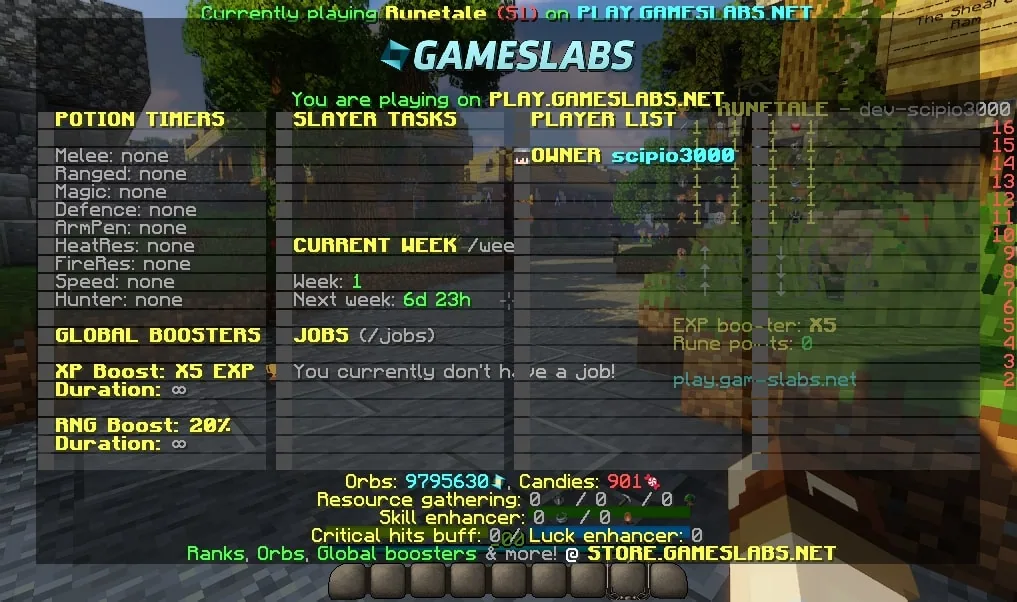
You hold one set at a time and there is no clock on it. Type /jobs or /job anywhere to reopen the list, and it also sits in your tab list while you play, each line grey until that task is done and green afterwards. The command is read only, though. Claiming a finished set, cancelling one and being dealt the next all happen face to face with a job master, and only the master's panel carries the buttons.
What a job can ask for
The pool is built out of things the game really contains, so a job never points at a recipe or a resource that does not exist. Gathering tasks cover mining ore and rune essence, chopping logs, picking crops and picking herbs. Production tasks cover cooking, firemaking, crafting, smelting, smithing, fletching, runecrafting and brewing. Fishing tasks name a single fish. Hunter tasks name a single creature to catch, anything from a crimson swift to a kebbit.
How much you are asked for depends on the type. Gathering, fishing and hunter tasks want 30 to 50, cooking and firemaking 20 to 35, and anything you produce at a furnace, anvil, altar or workbench 10 to 20. Every figure is rounded to a multiple of five. Things are deliberately kept out so sets stay workable, among them quest items, jewellery, gems, light sources, dyes, arrow shafts, goblin mail, elemental bars, implings and the most basic cooked meats.
How your tasks are chosen
Two gates decide what can appear. You must already have the skill level for a task, so a job is never a wall you cannot climb. And a task's requirement can sit at most five levels above your Exploration level, which makes Exploration the ceiling on how demanding your work is. At Exploration 1, nothing above level 6 can be drawn. Push Exploration up and harder, better paying tasks come into range across every skill at once.
Once a skill reaches level 50 the floor rises too. Tasks more than 30 levels below you stop appearing in that skill, and if you have outlevelled everything it offers, the same 30 level window is measured down from its hardest task instead of from your level. Each slot in a set picks a skill first and a target inside it second, so a set usually spreads across several skills rather than piling into one. A task whose requirement matches your current level exactly almost always wins that roll.
Doing the work
Nothing is handed in and nothing is taken off you. Do the activity as you normally would, keep everything you produce, and the counter moves on its own. Gathering counts what the node actually gives, so a rock that drops two ore counts two. Runecrafting counts essence converted rather than runes made, one for each essence. Logs thrown on a bonfire count towards a firemaking task exactly as lighting your own fire does.
Completed tasks turn green in the panel and in the tab list. When the last one lands you get a chat line saying the set is done, and the exploration point is paid on the spot, before you go anywhere. The coins and the Exploration experience wait at a job master, so make the walk back and right-click: the payout and your next set arrive in the same click.
What a set is worth
Coins are the simple part. Each completed task pays 50 for every level of its requirement, so a task gated at level 20 pays 1,000 and one gated at 60 pays 3,000. The hardest tasks in the game sit in the nineties and pay close to 5,000 each. Tasks you did not finish pay nothing at all.
Exploration experience is the activity's own rate multiplied by the amount asked. A job for 40 of something worth 50 experience each pays 2,000 Exploration experience, on top of the ordinary skill experience you already banked while doing it. Jobs are the part of Exploration you can do on demand. Clue scrolls, beacons and collection log finds pay it in lumps instead. The panel shows the exact figure for each task, finished or not.
Exploration levels buy access. Four locked doors each want a key and a level: 20 for the brass key on the shed leading to the hill giants, 40 for the golden doors in Taverley's maze, 50 for the experiment cave, 55 for the locked door in the Kalphite Cave. Clue scrolls are gated the same way, from beginner at level 1 up to master at 80. Each fully finished set also pays one exploration point, and points buy nothing but jobs themselves.
Getting out of a bad set
Three buttons sit at the end of the master's panel, the two point ones showing your current balance. Part-complete costs one exploration point and only appears once at least one task is finished. It pays the coins and Exploration experience for the tasks you did complete, drops the rest, and deals you a new set. It pays no exploration point, so you are spending a point to salvage part of a set rather than to earn one.
Cancel for three exploration points and cancel for 1,500 coins do the same job: bin the set, pay nothing, deal a fresh one. The coin version takes the money from your inventory, or from your bank if your pockets are short, so you do not have to be carrying it. Both throw away any task you had already finished, which is why part-completing is usually the better button whenever something is green.
The kinds of job
Mine ore or rune essence, chop logs, pick crops, pick herbs. 30 to 50, counted by what the node actually drops.
Catch a named fish at any spot that produces it. 30 to 50.
Trap a named hunter creature: birds, butterflies, kebbits and the like. Implings never appear. 30 to 50.
Cook a named dish. The most basic meats are excluded. 20 to 35.
Light a named log, or feed the same log to a bonfire. 20 to 35.
Make a hide or leather piece, a staff or wand, a fishing net, a rope or an unblessed symbol, or smelt a named bar. 10 to 20.
Hammer out a named item at an anvil. Elemental bars are excluded. 10 to 20.
Cut, string or assemble a named bow, crossbow, shield or piece of ammunition. Arrow shafts never count. 10 to 20.
Mix a named potion. 10 to 20.
Turn rune essence into a named rune at its altar. 10 to 20, counted one per essence.